
A 30-Day Journey into Advanced Portuguese
Master C1/C2 Level Grammar Through an Immersive Story
Story Description
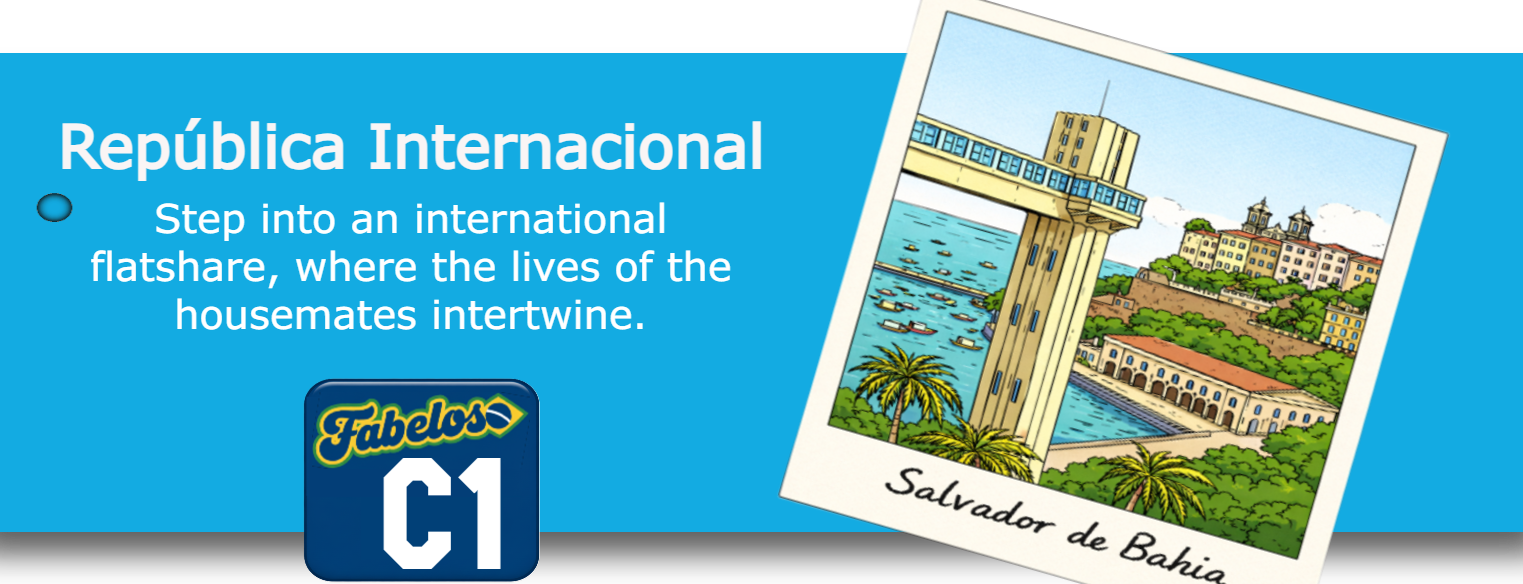
Step into a vibrant international flatshare in Brazil, where the lives of diverse housemates intertwine. Over 30 episodes, you’ll follow their personal dramas, cultural clashes, and unexpected friendships, all while being immersed in authentic, advanced Portuguese. This isn’t just a story; it’s a living language lab where every conversation reveals the nuanced grammar and rich vocabulary of high-level fluency.
Gradual Difficulty Progression
This course is meticulously structured for C1 to C2 learners. The story begins with complex but accessible narrative structures, gradually introducing the most sophisticated grammatical forms. Each episode builds upon the last, layering advanced conjunctions, literary tenses, and regional expressions into the dialogue and narration, ensuring a natural and challenging progression towards mastery.
Week 1
On move-in day, three international flatmates—a German student, an Angolan artist, and an Argentine chef—meet their Bahian landlord. They navigate complex house rules, cultural expectations, and the inherent perplexity of shared living in Salvador.
The international flatmates struggle with Salvador’s oppressive heat and the fluid concept of ‘tempo baiano.’ A planned group outing dissolves as they learn that punctuality here is a relative, abstract ideal rather than a tangible schedule.
Argentine chef Mateo attempts to make acarajé at home, causing a smoky disaster. The Bahian landlord intervenes, explaining the sacredness of dendê oil and cultural nuances of this traditional dish.
A plumbing emergency in the república becomes a linguistic adventure when Seu Zé, a local plumber, arrives speaking pure Baianês. The international flatmates struggle to decipher his slang-filled instructions, leading to comical misunderstandings and a deep dive into Salvador’s unique dialect.
The flatmates navigate Salvador’s largest market, overwhelmed by sensory chaos. Amid bargaining and cultural confusion, they confront the inherent contradictions of urban life, leading to unexpected epiphanies about belonging.
A routine Saturday cleaning at the Salvador flatshare erupts into a heated intellectual debate about cultural hygiene standards, domestic labor equity, and the philosophical nature of cleanliness itself, forcing the flatmates to confront their deepest assumptions.
Klaus, a German student, attempts to master Salvador’s chaotic bus system during rush hour, confronting cultural differences and existential dread while discovering unexpected camaraderie and local wisdom.
Week 2
The flatmates prepare offerings for the Festival of Iemanjá on February 2nd. A philosophical discussion about religious syncretism in Bahia unfolds, exploring the fusion of African, Catholic, and Indigenous beliefs through personal stories and regional idioms.
Lena, the German flatmate, attempts to renew her student visa, encountering the bewildering bureaucracy of Brazilian notary offices and police stations, leading to philosophical debates about systemic absurdity.
A persistent rainy afternoon in Salvador plunges the flatmates into melancholy. They share profound stories of homesickness, debating the untranslatable nature of ‘saudade’ across their native languages and personal experiences.
Dona Lourdes, the neighborhood gossip, complains about the flat’s noise but always brings them fresh cake. The flatmates discover her secret love for their vibrant gatherings and use pragmatism to turn her into an unlikely ally.
A sudden power outage plunges the flatshare into darkness. As candles are lit, the roommates share local ghost stories and urban legends, revealing cultural fears and beliefs through sophisticated, idiomatic Portuguese.
The Angolan artist Kiluanji experiences a profound realization about the shared African heritage in Salvador’s capoeira, connecting Angola’s history with Bahia’s living traditions through complex emotions and historical reflections.
A passive-aggressive note about stolen leftovers escalates into a formal house meeting. The flatmates engage in hilariously articulate accusations and defenses, revealing deeper cultural clashes about food, property, and communal living in Salvador.
Week 3
As Salvador transforms for Carnival, the flatmates face the overwhelming task of choosing blocos and buying abadás. Their discussions reveal deep cultural anxieties, personal pragmatism, and the complex social dynamics beneath the festive surface.
The flatmates accidentally adopt a stray street dog, leading to chaotic logistics, cultural clashes about pet ownership, and deep reflections on responsibility in Salvador’s unique urban landscape.
The Bahia vs. Vitória derby brings Salvador to a standstill. As the flatmates navigate the city’s divided loyalties, they experience the raw passion of stadium culture, leading to personal revelations about identity and belonging.
When the traditional parents of the Bahian landlord arrive unexpectedly, the modern international flatmates must navigate conservative hospitality, cultural clashes, and generational differences in their Salvador flatshare.
Lena, the German flatmate, attempts to master the complex social dance of haggling at Salvador’s historic market. Through a series of interactions, she learns that commerce here is less about price and more about establishing human connection and mutual respect.
On Ash Wednesday, the flatmates confront the physical and emotional cleanup after Carnival. Amid exhaustion, they reflect on the ephemeral nature of celebration while witnessing Salvador’s slow return to its everyday rhythm.
A late-night debate on the porch of their Salvador flatshare forces the international residents to confront the fine line between cultural appreciation and appropriation as foreigners living in Bahia.
Week 4
Lena, the German flatmate, falls for an intricate scam involving fake colonial coins in Salvador’s historic center. The experience becomes an empirical lesson in Bahian street smarts, challenging her paradigm of trust.
The flatmates prepare a traditional Sunday moqueca. Through the meticulous process, they discuss the indigenous and African roots of ingredients, deconstructing simplistic dichotomies while navigating cultural nuances with pragmatism.
A sudden two-day water cutoff in Salvador exposes the flatmates’ vulnerabilities and privileges. Through rationing, improvisation, and heated discussions, they confront the fragility of urban infrastructure and their own cultural assumptions about a basic resource.
Angolan artist Kiala hosts his first gallery exhibition in Salvador’s bohemian Rio Vermelho district. The night reveals cultural complexities, artistic epiphanies, and the underlying tensions between commercial success and authentic expression.
The flatmates volunteer at a community center in a Salvador favela, mixing cement and teaching children. The day’s physical labor and conversations force them to confront Brazil’s stark inequality and question the true impact of their actions.
The flatmates are invited to an authentic backyard samba de roda in Salvador’s historic district. Through participation, they learn the unwritten rules of the circle, the poetry of the lyrics, and the complex social dynamics that govern this traditional gathering.
When two flatmates contract dengue fever, the community mobilizes with local remedies and SUS navigation, revealing cultural clashes and syncretic healthcare approaches during Salvador’s epidemic season.
Week 5
Lukas’s visa expires, forcing a farewell. The república organizes a churrasco where emotions surface, revealing hidden truths and the complex nature of saying goodbye in Salvador.
The flatmates gather at Porto da Barra for a final sunset. As they reflect on their transformative time in Salvador, they realize how the city’s intangible rhythms have fundamentally reshaped their worldviews and personal paradigms.
Klaus, a German student, struggles with Salvador’s oppressive heat and the fluid concept of time. A planned group outing dissolves as ‘tempo baiano’ takes over, teaching him that schedules here bend to social warmth rather than clocks.
What Makes This Series Effective
- Emotional Engagement: You learn grammar not as rules, but as the tools characters use to express regret, doubt, formality, and wit, making the structures memorable and meaningful.
- Contextualized Learning: Every advanced grammatical concept is embedded within real-life scenarios—from heated kitchen debates to heartfelt confessions—providing the perfect context for understanding usage.
- Deep Comprehension Testing: Exercises go beyond simple recognition, challenging you to interpret subtle meanings, authorial intent, and the emotional subtext conveyed by complex grammar choices.
Vocabulary & Grammar Coverage
This series pushes your fluency by focusing on:
- Grammar Focus: Master literary tenses (Pretérito Mais-que-perfeito), hypotheticals (Futuro do Pretérito), advanced subordinate clauses, and the nuanced use of the subjunctive for emotion. Decode formal structures like mesóclise mixed with everyday colloquial speech.
- Vocabulary Focus: Acquire a rich lexicon related to shared living, interpersonal dynamics, and Brazilian culture, seamlessly integrated with regional idioms and slang (like Baianês) for authentic expression.
Perfect For
Cultural Enthusiasts: Learners who want to move beyond textbook Portuguese and experience the language as it’s woven into the fabric of Brazilian stories and relationships.
Advanced Learners (C1): Students who understand the basics and are ready to tackle the elegance and complexity of formal, literary, and nuanced Portuguese.
Aspiring Translators & Linguists: Professionals who need to deconstruct and comprehend the full spectrum of the language, from street talk to prose.