
An Immersive B2/C1 Level Course
Story Description
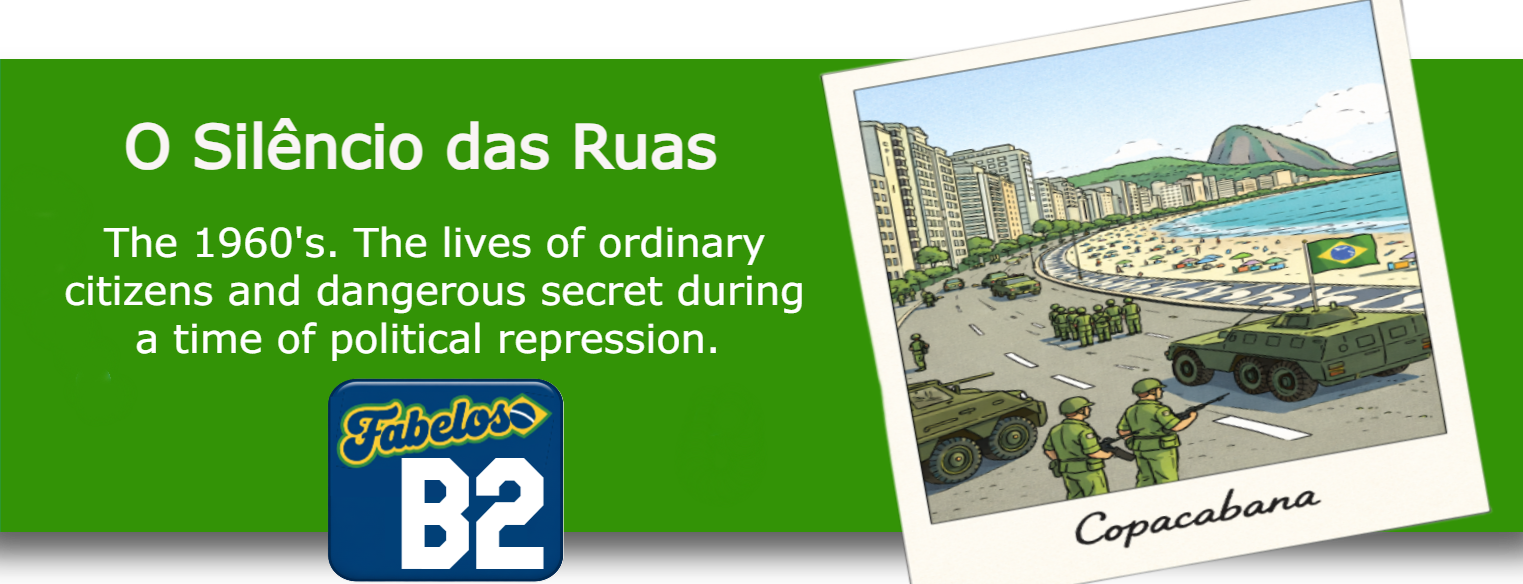
Step into the shadows of a pivotal moment in history with “O Silêncio das Ruas,” a gripping 10-episode series. You’ll follow a network of ordinary citizens whose lives become entangled in a dangerous secret during a time of political repression. As whispers of resistance grow, you’ll navigate tense encounters, decipher coded messages, and experience the personal cost of courage, all while immersing yourself in authentic, narrative-driven Portuguese that brings the past to life.
Gradual Difficulty Progression
Designed for high-intermediate to advanced learners (B2/C1), this course begins by solidifying your grasp of core narrative tenses (Pretérito Perfeito vs. Imperfeito). Each episode naturally introduces a new layer of grammatical complexity, from expressing prior events with the Pretérito Mais-que-perfeito to weaving hypothetical scenarios and nuanced opinions. By the final episodes, you’ll be comfortably parsing complex sentences featuring indirect discourse and the subjunctive mood, achieving the sophisticated language control expected at the C1 level.
Placeholder – paste
Episódios
In 1968, Dona Lúcia, a 58-year-old widow who runs a bakery in Copacabana, hides a bleeding young man from the political police. When officers arrive, she lies to protect him, discovering unexpected courage in her apolitical daily life.
On December 13, 1968, Sergeant Rocha of DOI-CODI receives orders to interrogate a philosophy professor and mother of two. He does not personally torture her but hears her screams from the next room. That night, tormented by his complicity, he writes a resignation letter but cannot bring himself to send it.
Sister Teresa, a nun working in a Rio favela, secretly shelters political fugitives. Soldiers raid her chapel, accusing her of hiding ‘terrorists.’ She is arrested and spends three days in jail, but returns to her community, embodying religious resistance against the regime’s oppression.
Inez, a secretary at the Ministry of Labor, is asked by her boss to observe a colleague. She complies, leading to the colleague’s dismissal and her own promotion. This pattern repeats, turning Inez into the office informant. One night, she sees the first woman she denounced now living on the street but walks past, consumed by guilt and survival.
Renato, recently released after torture, joins the historic 1968 March of the One Hundred Thousand in Rio de Janeiro. Helena searches for her son Marcelo in the crowd, while Dona Lúcia and Irmã Teresa participate. For one afternoon, the streets belong to the people in a massive, peaceful protest against the dictatorship.
Helena receives a call from her ex-husband in Paris after six years in hiding. He asks her to bring their son Marcelo. Faced with staying in a safe but empty Brazil or leaving everything behind, Helena chooses exile. On the plane to Paris, Marcelo asks if they’ll ever return.
In 1971, Sergeant Rocha arrests Marcelo, a student distributing pamphlets. Recognizing Marcelo as Helena’s son and seeing his own youthful idealism reflected, Rocha releases him, destroys the file, and writes an unsent letter of confession and regret.
What Makes This Series Effective
- Emotional Engagement: The thriller format creates suspense and emotional stakes, making you *need* to understand the next line of dialogue or narrative clue, which dramatically boosts retention and motivation.
- Contextualized Learning: Every advanced grammar point is not a standalone rule but a tool used by characters to argue, reminisce, speculate, or report events, showing you exactly how and why native speakers use these structures.
- Deep Comprehension Testing: Quizzes and exercises go beyond simple translation, challenging you to interpret character motives from indirect discourse, understand implications from hypotheticals, and follow the timeline of events through complex tense usage.
Vocabulary & Grammar Coverage
This series pushes your fluency by focusing on:
- Grammar Focus: Master historical narration (Pretérito perfeito/imperfeito), express anteriority (tinha feito), and craft hypotheticals (Futuro do pretérito). Gain command of the subjunctive in concessive and adverbial clauses (embora, antes que), use both analytical and pronominal passive voice, and seamlessly navigate indirect discourse with tense shifts and free indirect speech.
- Vocabulary Focus: Acquire rich vocabulary related to history, society, politics, personal conflict, observation, and clandestine activities, all within the authentic context of the story.
Perfect For
Aspiring Advanced Speakers: Those targeting C1 proficiency, needing to practice the nuanced grammar of formal narration, argumentation, and detailed storytelling.
B1+ Learners Ready for a Challenge: Students who understand the basics and are ready to tackle complex, connected discourse and sound more sophisticated in their speech and writing.
History & Culture Enthusiasts: Learners who want to engage with meaningful, real-world themes and narratives while acquiring the language to discuss them in depth.